



Video Training → Real Python - Office Hours Archive with David Amos (2020 Collection)
Published by: voska89 on 25-08-2021, 21:05 |  0
0

MP4 | Video: h264, 1920x1080 | Audio: AAC, 44.1 KHz, 2 Ch
Genre: eLearning | Language: English | Duration: 18 Lessons (19h 31m) | Size: 11 GB
In this meeting, we talked about:
Video Training → Real Python - Exploring the Python math Module with Cesar Aguilar
Published by: voska89 on 25-08-2021, 21:05 | 0
MP4 | Video: h264, 1920x1080 | Audio: AAC, 44.1 KHz
Language: English | Size: 236 MB | Duration: 16 Lessons | 1h 20m
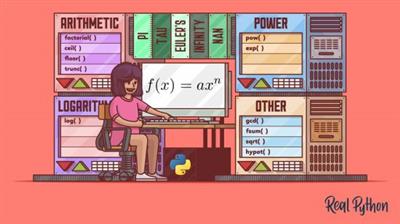
In this course, you'll learn all about Python's math module. Mathematical calculations are an essential part of most Python development. Whether you're working on a scientific project, a financial application, or any other type of programming endeavor, you just can't escape the need for math.
Video Training → Python Modulo Using the % Operator with Christopher Trudeau
Published by: voska89 on 25-08-2021, 21:05 | 0
MP4 | Video: h264, 1280x720 | Audio: AAC, 44.1 KHz, 2 Ch
Genre: eLearning | Language: English | Duration: 6 Lessons (33m) | Size: 65.3 MB
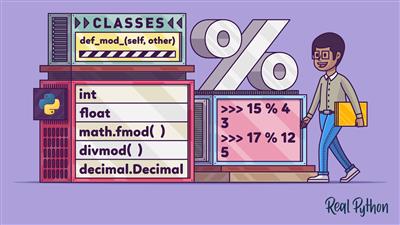
Python supports a wide range of arithmetic operators that you can use when working with numbers in your code. One of these operators is the modulo operator (%), which returns the remainder of dividing two numbers. Modular operations are useful to check if a number is even or odd, simplifying cycling through data, and doing non-decimal based units conversion.
Video Training → Navigating Namespaces and Scope in Python with Johan Vergeer
Published by: voska89 on 25-08-2021, 21:05 | 0

MP4 | Video: h264, 1920x1080 | Audio: AAC, 44.1 KHz, 2 Ch
Genre: eLearning | Language: English | Duration: 11 Lessons (27m) | Size: 44.2 MB
In a program of any complexity, you'll create hundreds or thousands of names, each pointing to a specific object. How does Python keep track of all these names so that they don't interfere with one another? This course covers Python namespaces, the structures used to organize the symbolic names assigned to objects in a Python program.
Video Training → SkillShare - The Data Science MicroDegree Introduction To Python Data Analysis and Visualization
Published by: Minhchick on 24-08-2021, 19:49 | 0

SkillShare - The Data Science MicroDegree Introduction To Python Data Analysis and Visualization-SkilledHares
English | Size: 3.30 GB
Category: Tutorial
We start from absolute Python scratch and gradually progress into NumPy, Pandas, Matplotlib & Seaborn for data analysis.
Video Training → Udemy - Python Game Projects (Level III)
Published by: voska89 on 24-08-2021, 10:49 | 0

MP4 | Video: h264, 1280x720 | Audio: AAC, 44.1 KHz, 2 Ch
Genre: eLearning | Language: English + srt | Duration: 8 lectures (4h 53m) | Size: 3.83 GB
Learn Python by Making Games From Scratch | From Zero to Hero
Video Training → Udemy - Python Django - The Full Stack Guide
Published by: voska89 on 24-08-2021, 10:49 | 0

MP4 | Video: h264, 1280x720 | Audio: AAC, 44.1 KHz, 2 Ch
Genre: eLearning | Language: English + srt | Duration: 78 lectures (5h 13m) | Size: 1.46 GB
Learn how to build real web applications (including a Social Media Platform) with Python and the Django framework
Video Training → Udemy - Learn Python Decorators
Published by: voska89 on 24-08-2021, 10:46 | 0

MP4 | Video: h264, 1280x720 | Audio: AAC, 44.1 KHz, 2 Ch
Genre: eLearning | Language: English + srt | Duration: 16 lectures (52m) | Size: 197 MB
Learn All About Python Decorators
Video Training → Udemy - Arduino meets Python Step by Step (updated 8.2021)
Published by: voska89 on 24-08-2021, 10:41 | 0
MP4 | Video: h264, 1280x720 | Audio: AAC, 44.1 KHz
Language: English | Size: 538 MB | Duration: 54m
What you'll learn
Video Training → Real Python - The Python range() Function with Austin Cepalia
Published by: voska89 on 24-08-2021, 10:35 | 0

MP4 | Video: h264, 1920x1080 | Audio: AAC, 44.1 KHz, 2 Ch
Genre: eLearning | Language: English | Duration: 5 Lessons (22m) | Size: 43.5 MB
Python's built-in range function is handy when you need to perform an action a specific number of times. As an experienced Pythonista, you've most likely used it before. But what does it do?

